Cat · both correct
DenseCNN spreads evidence across the cat's central body and head. CNN Best is more fragmented, with several small hotspots. Both predict cat, so a smoother map is not required for correctness.
A reproducible Apple Silicon study
We trained conventional CNNs, a recurrent CNN, MobileNet, a Vision Transformer, DynamicCNN, DenseCNN, and ResNet-50 on CIFAR-10. The goal is not only to identify a winner, but to understand the effects of capacity, normalization, feature reuse, training length, and parameter efficiency.
“ResNet-50 reached 92.94% test accuracy at its best epoch, 185/200. DenseCNN followed at 92.53% with only 300,634 parameters; CNN-C + BatchNorm remained the strongest standard CNN at 88.48%.”
Leaderboard
Every ranked row is a completed run. Click any column header to sort. Rows trained for only 30 epochs carry a distinct 30-epoch run badge so short experiments are never confused with full-length results.
| Rank | Model | Family | Size | Norm | Parameters | Best / target epoch * | Best val % | Test acc % | Status |
|---|
* Best / target epoch: 192/200 means epoch 192 had the highest validation accuracy during a 200-epoch run. Test accuracy is evaluated from that checkpoint, not automatically from the final epoch.
Dynamic CNN · dynamic size · BatchNorm
Validation and test results conflict — 70.46% validation against a 10.00% test result. Excluded from all scientific conclusions pending investigation.
Visual evidence
Test accuracy, parameter efficiency across the whole field, and complete training-loss trajectories generated directly from the synchronized result files.
Final test accuracy evaluated from each run's best-validation checkpoint.
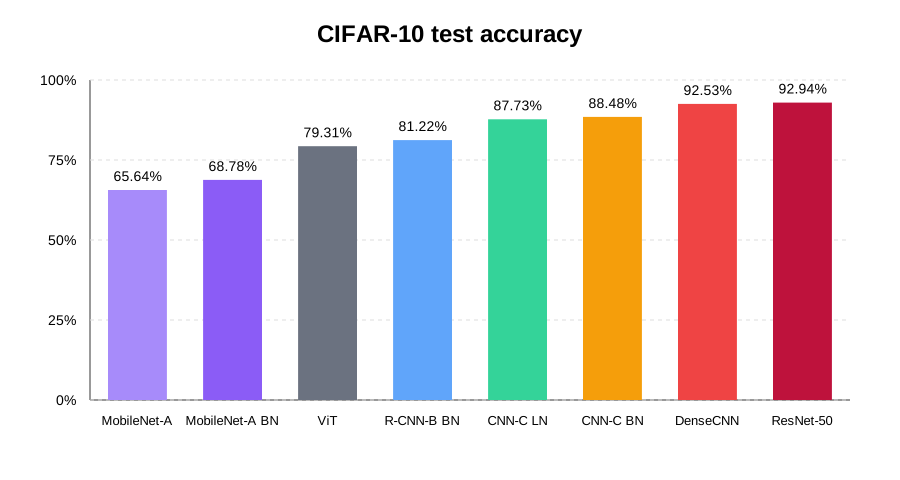
ResNet-50's best / target epoch is 185/200; DenseCNN's is 192/200. R-CNN-B + BN and MobileNet-B remain 30-epoch runs.
Trainable parameters on a logarithmic x-axis against test accuracy. Colors separate architecture families and nearby labels use leader lines.
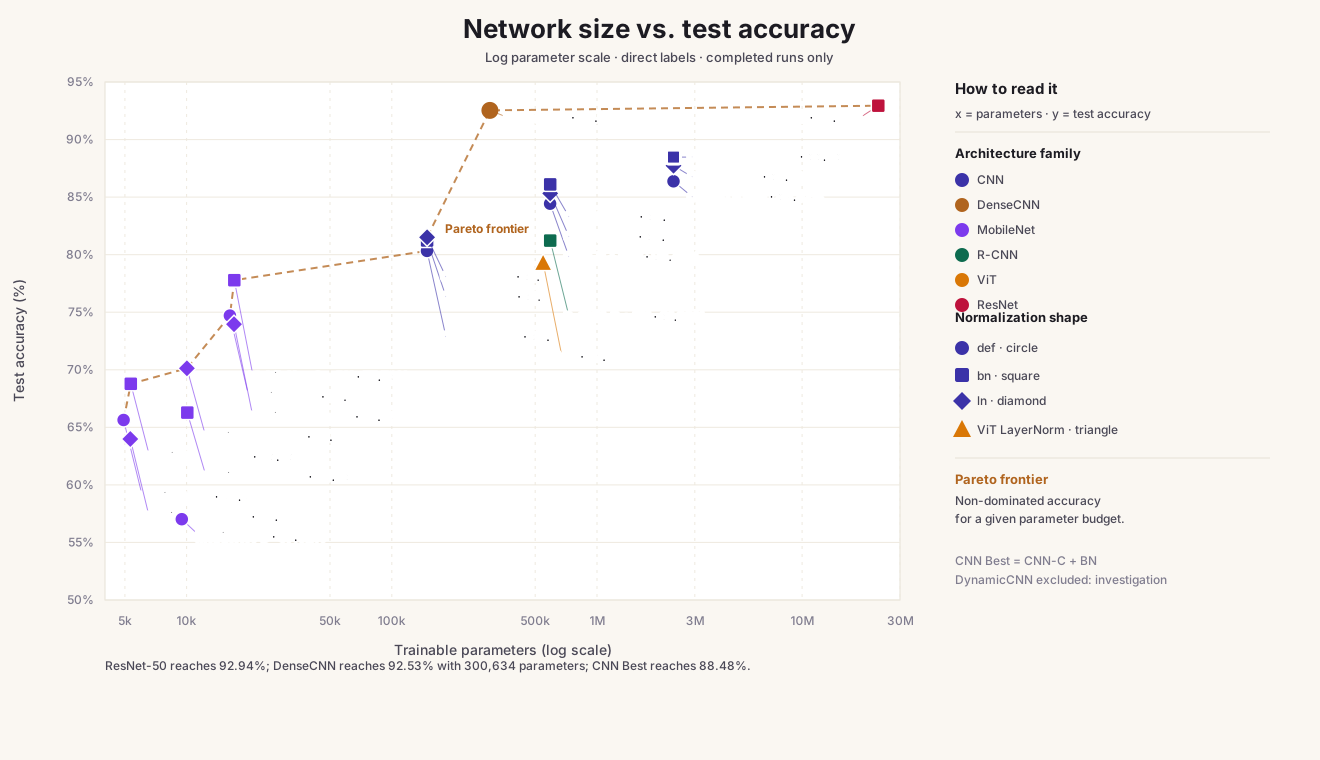
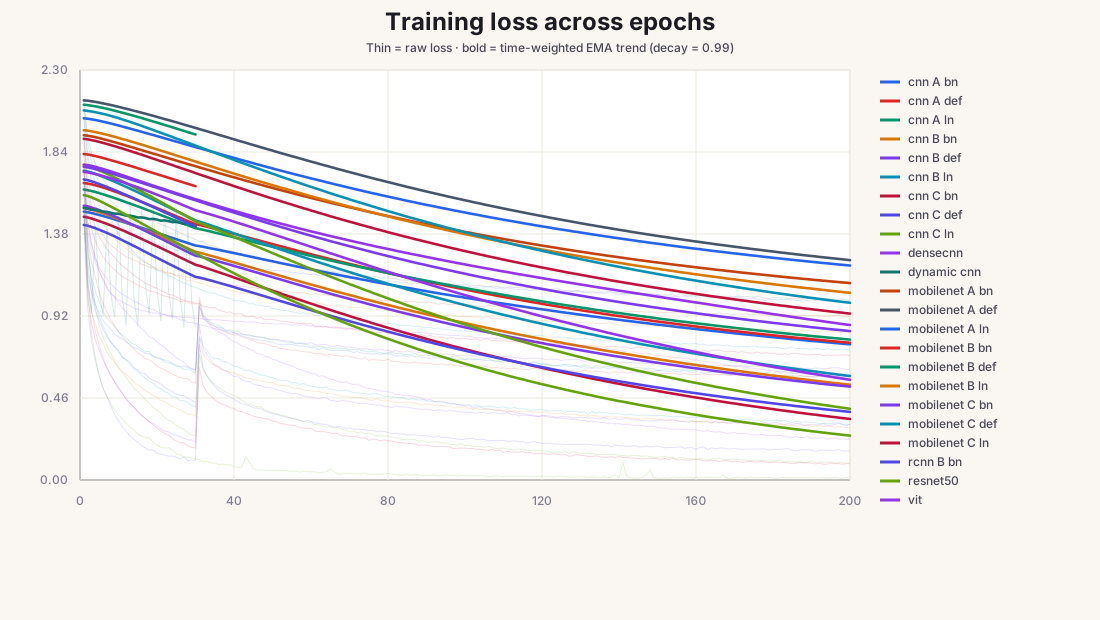
Full per-epoch histories. Thin lines retain raw loss; bold lines show your time-weighted EMA trend (decay = 0.99). Unequal line lengths make the 30- and 200-epoch budgets visible.
Independent reproduction
This second run uses the CUDA-optimized pipeline (GPU-resident tensor shards, GPU-side augmentation, batch size 1024). It is reported separately from the MPS leaderboard because the accelerator and input pipeline changed.
| Model | Best / target | Best validation | Test accuracy | Parameters |
|---|---|---|---|---|
| ResNet-50 | 191/200 | 92.60% | 91.80% | 23,520,842 |
| DenseCNN | 191/200 | 92.10% | 91.50% | 300,634 |
| CNN-C + BN | 200/200 | 89.00% | 88.35% | 2,360,906 |
| ViT | 174/200 | 81.24% | 80.15% | 546,186 |
Open all CUDA runs in W&B ↗ · Download CUDA checkpoints and JSON metadata ↗. Full matrix: reports/cuda_summary.json.
Model zoo
Each family probes a different design question: capacity, normalization, recurrence, efficiency, attention, feature reuse, and residual depth.
Two convolution stages and a compact classifier. Channel widths increase from 16/32 to 32/64 and 64/128, making capacity easy to compare.
BatchNorm normalizes batch statistics. The LN option uses one-group GroupNorm. The default variant has no normalization.
A recurrent convolutional classifier, not a region detector. It repeatedly applies a shared convolution with a residual update.
Depthwise spatial convolution plus 1×1 pointwise projection sharply reduces parameter count.
A 32×32 image is split into 4×4 patches. Each patch is flattened and linearly projected to a 128-dimensional token before four Transformer layers.
Dense layers append new features to all earlier features. Transitions compress channels and global average pooling replaces a large classifier.
A CIFAR-adapted ResNet-50 uses a 3×3 stride-1 stem without the ImageNet max pool.
Interpretability
DenseCNN, the strongest compact feature-reuse model (92.53%), is compared with CNN Best—the strongest original baseline configuration, CNN-C + BatchNorm (88.48%)—on exactly the same four CIFAR-10 test images. This controls the input while exposing differences in spatial evidence.
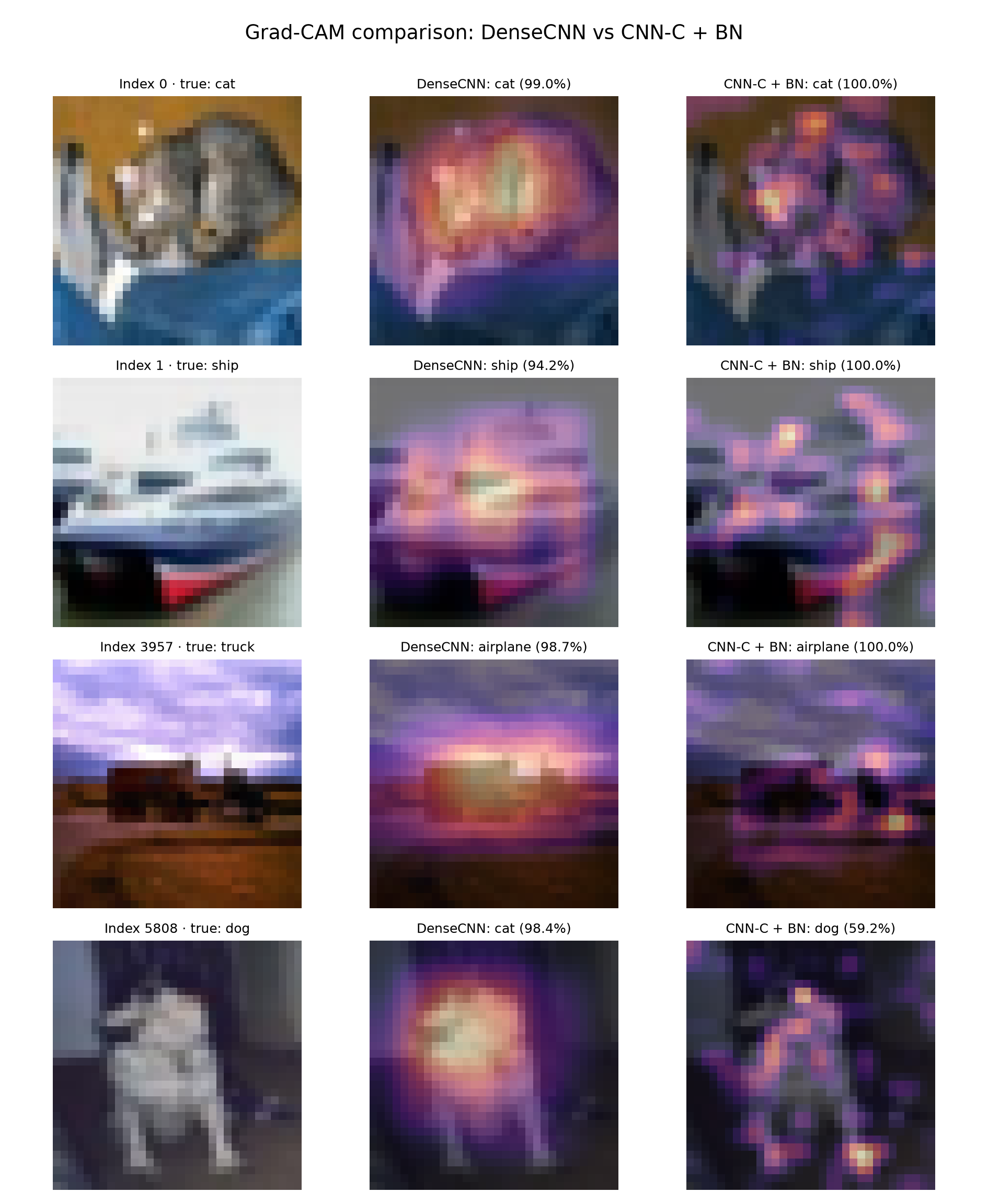
DenseCNN spreads evidence across the cat's central body and head. CNN Best is more fragmented, with several small hotspots. Both predict cat, so a smoother map is not required for correctness.
DenseCNN emphasizes a broad vessel region. CNN Best reacts to separated structural details and the lower-right hull. Their different spatial strategies still reach the same class.
Both models predict airplane with extreme confidence. DenseCNN follows the elongated object and horizon; CNN Best concentrates on smaller edges. The shared error suggests ambiguous low-resolution shape cues, not merely poor localization.
DenseCNN collapses onto the bright torso/head region and predicts cat at 98.4%. CNN Best distributes evidence across the dog's body and extremities, predicting dog at 59.2%. This counterexample matters: the higher-scoring model is not better on every image.
Synthesis
Seven findings that survived scrutiny across the whole study.
Reproducibility
Every run in this study executed on the same single machine, with the software stack pinned below.